QoE-Oriented Rate Control and Resource Allocation for Cognitive M2M Communication
A short write-up of my IEEE Access paper. Read the published version on IEEE Xplore or download the PDF.
Highlights
- A novel QoE-oriented uplink rate control and resource allocation scheme is proposed, for IoT using time-varying channels.
- A Mean Opinion Score (MOS) model is designed to measure the degree of Quality of Experience (QoE).
- The original long-term optimization problem is converted into an admission rate control subproblem and a resource allocation subproblem in each time slot, based on Lyapunov optimization.
- Gale–Shapley matching is utilized, exploiting the special structure of the resource allocation subproblem.
Scenario
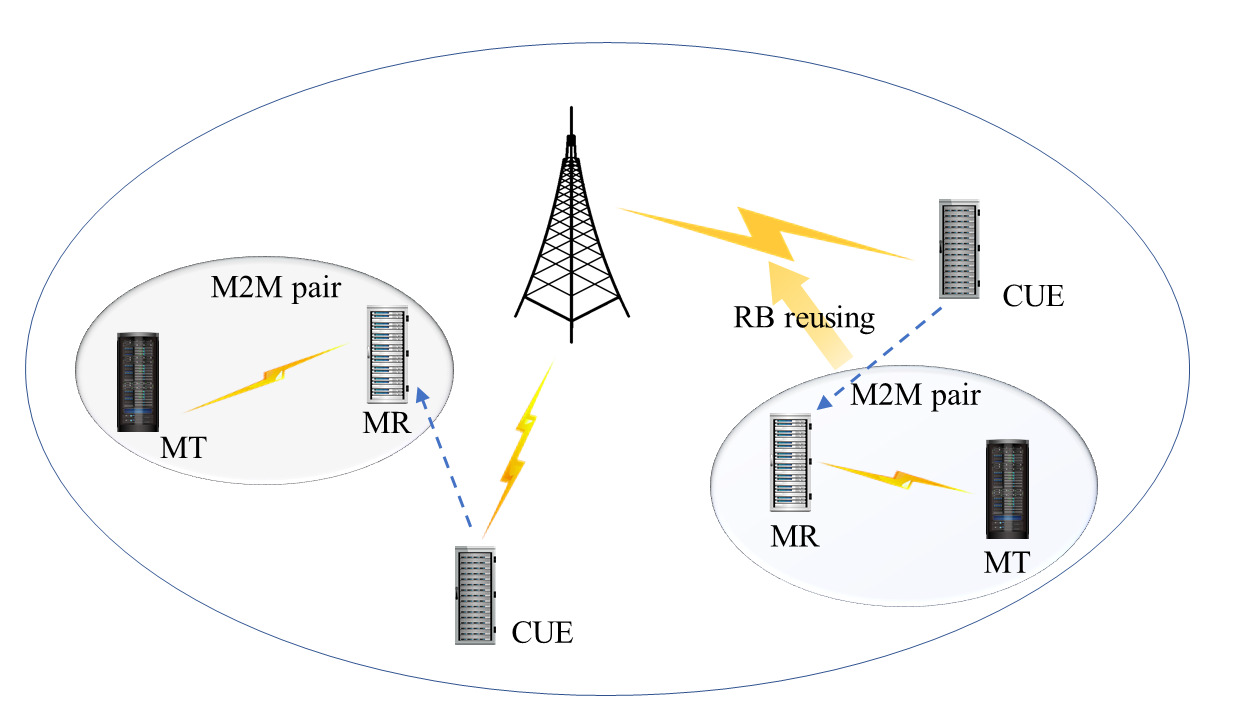
Figure 1. System model of M2M-based uplink IoT network.
As shown in Figure 1, we consider a cognitive Machine-to-Machine (M2M) network, which consists of a centralized Base station (BS), $K$ Cellular user equipments (CUEs), and $N$ M2M pairs.
Each CUE occupies one orthogonal spectrum sub-channel of equal bandwidth to perform uplink communication with the BS. The sets of CUEs and sub-channels are denoted as $\mathcal {C}= \lbrace C_1,C_2,$ $\ldots, C_k,$ $\ldots, C_K\rbrace$ and $\mathcal {S}=\lbrace S_1, S_2,$ $\ldots, S_k,$ $ \ldots, S_K\rbrace$, respectively. The sets of indices are denoted as $\mathcal {K}= \lbrace 1, 2,$ $\ldots, k,$ $\ldots, K\rbrace$.
Each M2M pair is composed of a M2M transmitter (MT) and a M2M receiver (MR). To implement the cognitive M2M communication, each M2M pair has to reuse the sub-channel allocated to a CUE. Denote the sets of M2M pairs as $\mathcal {M}= \lbrace M_1, M_2, $ $\ldots, M_n,$ $\ldots, M_N\rbrace$ and the sets of corresponding indices as $\mathcal {N}= \lbrace 1, 2,$ $\ldots, n,$ $\ldots, N\rbrace$. And the sets of MTs and MRs of M2M pairs are denoted as $\mathcal {MT}= \lbrace MT_1, MT_2, $ $\ldots, MT_n,$ $\ldots, MT_N\rbrace$, $\mathcal {MR}= \lbrace MR_1, MR_2, $ $\ldots, MR_n,$ $\ldots, MR_N\rbrace$, respectively.
A M2M pair is allowed to reuse the CUE's sub-channel for data dissemination if and only if certain constraints are satisfied, e.g., the rate and the delay constraints. Intuitively, a CUE is more willing to share its sub-channel with a M2M pair which causes less interference to it, and is more likely to refuse the request of a M2M pair which causes serious interference.
Algorithm
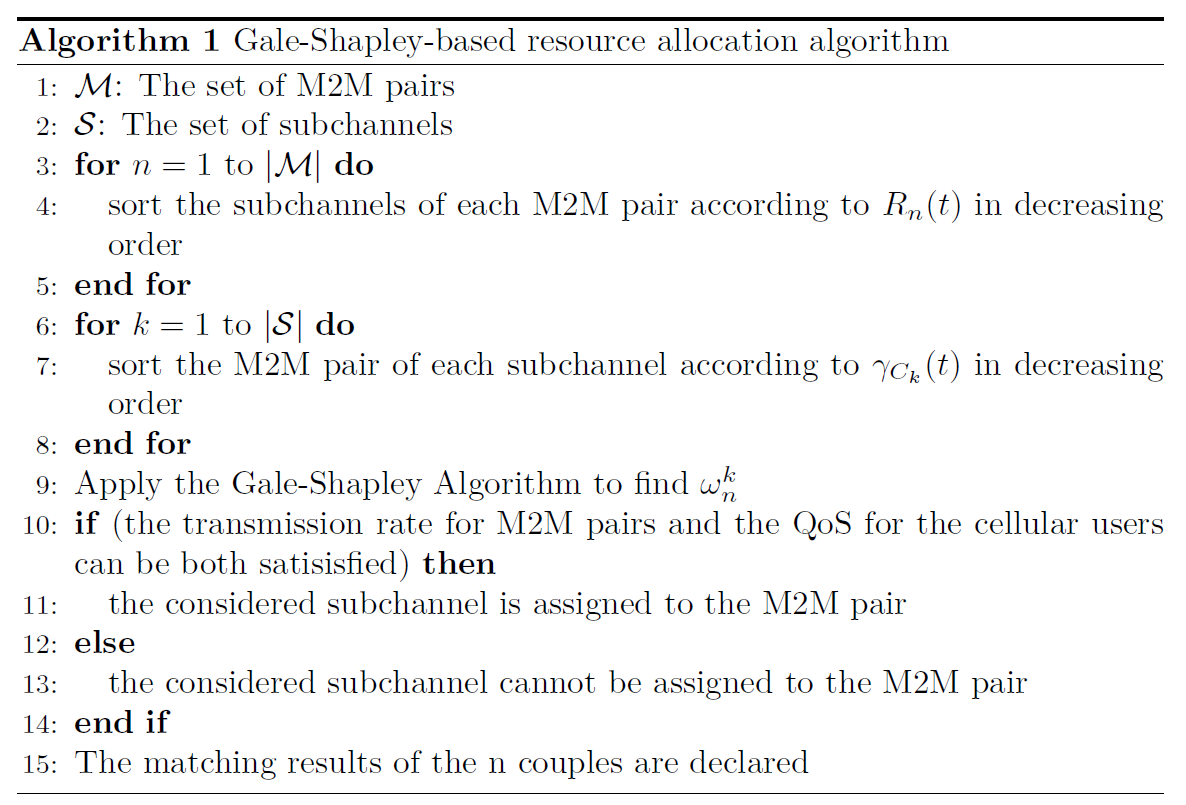
Figure 2. Gale–Shapley matching between M2M pairs and sub-channels.
\begin{algorithm}[!htbp]
    \caption{Gale-Shapley-based resource allocation algorithm}
    \begin{algorithmic}[1]
        \STATE $\mathcal {M}$: The set of M2M pairs
        \STATE $\mathcal {S}$: The set of subchannels
        \FOR{$n=1$ to $| \mathcal {M}|$}
        \STATE sort the subchannels of each M2M pair according to $R_{n}(t)$ in decreasing order
        \ENDFOR
        \FOR{$k=1$ to $| \mathcal {S}|$}
        \STATE sort the M2M pair of each subchannel according to $\gamma_{C_{k}}(t)$ in decreasing order
        \ENDFOR
        \STATE Apply the Gale-Shapley Algorithm to find $\omega_n^k$
        \IF{(the transmission rate for M2M pairs and the QoS for the cellular users can be both satisfied)}
        \STATE the considered subchannel is assigned to the M2M pair
        \ELSE
        \STATE the considered subchannel cannot be assigned to the M2M pair
        \ENDIF
        \STATE The matching results of the n couples are declared
    \end{algorithmic}
\end{algorithm}
Citation map
As of a September 2022 snapshot, this paper had been cited 15 times (see Google Scholar):